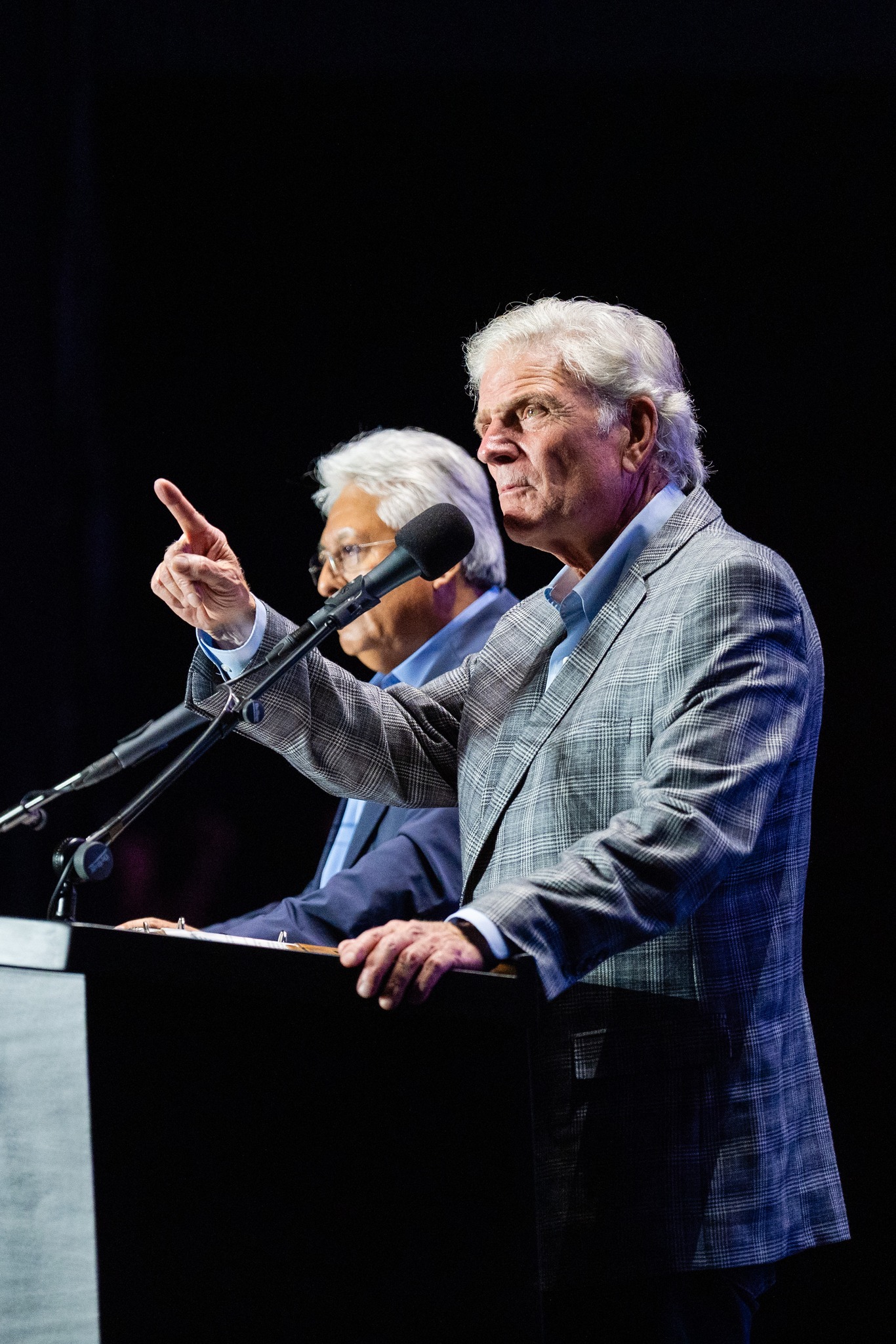
A growing theological and political debate is unfolding within global Christianity after evangelist Franklin Graham publicly challenged remarks by Pope Leo XIV, who recently stated that God rejects the prayers of those who wage war.
The exchange, which comes during the lead-up to Easter, has drawn international attention as it touches on deeply contested questions surrounding faith, violence, and the role of Scripture in modern geopolitical conflict.
During a Palm Sunday homily, Pope Leo XIV cited Isaiah 1:15 in warning that God does not listen to prayers offered by those whose "hands are full of blood," framing his remarks within a broader call for peace amid escalating global tensions. His statements, widely reported across major outlets, reflect a continued emphasis within the Vatican on rejecting the use of religion to justify violence and urging moral accountability among world leaders.
Responding in an interview on Piers Morgan Uncensored, Graham offered a sharply different perspective. Pointing to the biblical example of King David, he argued that Scripture demonstrates instances where God supports those engaged in battle. "God does take sides in history," Graham said, emphasizing that divine favor was evident in David's victories.
While affirming that he does not support war in general, Graham defended the concept of "just war," suggesting that certain conflicts-such as World War II-can be morally justified when confronting evil. He also described the Iranian regime as a global threat and expressed hope for political change, situating his remarks within ongoing international tensions.
The discussion has not gone unchallenged. Avraham Burg, a former speaker of the Israeli Knesset, criticized Graham's interpretation of King David, noting that although David was a warrior, he was ultimately prohibited from building the temple because of the bloodshed associated with his reign. Burg argued that this biblical detail complicates attempts to frame warfare as divinely sanctioned.
Burg also warned against merging theological expectations with modern political agendas, urging Christians to avoid allowing eschatological beliefs to shape contemporary conflicts. Drawing from personal and national experience, he emphasized the devastating human cost of war and called for greater separation between faith and geopolitical strategy.
The controversy is further amplified by Graham's recent prayer at a White House Easter gathering, where he invoked the biblical story of Esther and suggested that modern political leaders may be raised up "for such a time as this." The prayer, delivered in the context of ongoing conflict involving Iran, has prompted additional scrutiny regarding the intersection of faith, politics, and international policy.
Observers note that the disagreement reflects a broader divide within global Christianity. On one side, Pope Leo XIV's remarks align with a growing emphasis-particularly within Catholic teaching-on peacebuilding, reconciliation, and skepticism toward traditional "just war" frameworks. On the other, Graham's comments reflect a perspective more common within segments of evangelical Christianity that affirm the possibility of morally justified conflict grounded in biblical precedent.
As Easter approaches-a season centered on Christ's victory over sin and death-the debate introduces a sobering layer to the Church's proclamation of peace. At its core are enduring questions: Can war ever be justified within a biblical worldview? How should ancient Scripture be applied to modern conflicts? And what does it mean to follow the Prince of Peace in a world marked by violence?
With voices across the Christian spectrum weighing in, the conversation is likely to continue beyond Easter, shaping how believers engage both theology and public life in an increasingly complex global landscape.


